
Radii
Radio used to be the easy way to have music on. Radii is a speaker with knobs that tune the era, tempo, genre and mood of what plays, and no screen anywhere.
Radii is a speaker built like a guitar amp, and its knobs tune the music, not the tone.
There's a row of them across the top. Each one tunes the music itself: Era runs from older on the left to newer on the right, then Tempo, Genre and Mood. Turn them to 1972, 98 bpm, soul and warm, and it plays a station that matches and keeps going on its own as long as it is on.
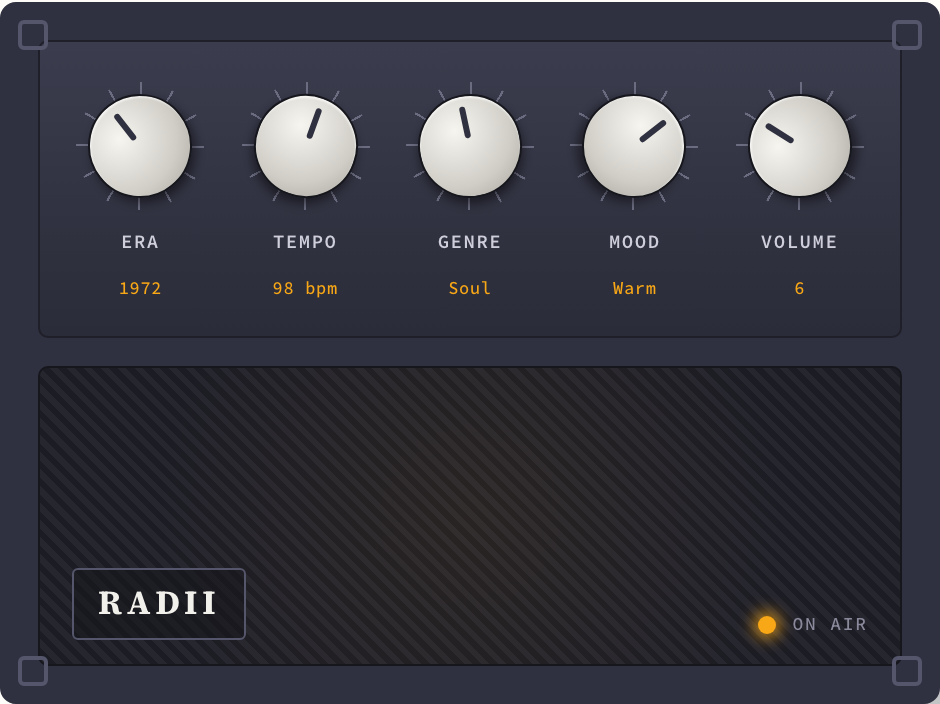
You tune into a station, you never pick the song
There is no app to open and no pairing step. Flip it on and it plays. Move a dial and the station follows; save a setting as a preset and snap back to it later like a saved station. Radii never shows what is playing. The next song arrives without a decision, and the pleasure is finding you tuned into the right thing. The person it is for owns a turntable and likes the ritual, but some nights wants good music on with nothing to choose. Today that person uses a Sonos and a saved playlist.
Three places want a radio nobody has to set up:
- A shelf at home, next to the record player
- Hotel rooms and Airbnbs, where a guest turns it on with no login
- Bars, cafes and offices, where anyone in the room can nudge the dials without borrowing a phone, on a commercial music license
Never picking the song is the point
Radii never lets you choose a track, and two things follow from that. The first is that the phone stays in your pocket. There is nothing to search, scroll or queue, so nobody in the room is holding a screen to keep the music going.
The second is the license. Choosing songs on demand needs a deal with every label, which is what makes streaming services expensive to run. A station nobody can steer to a specific track is radio, and US law gives any non-interactive internet radio service a compulsory license to play commercially released recordings, the one Pandora was built on. There is no label negotiation: the service files and pays a set royalty per song per listener. In Arista v. Launch Media (2009), a federal appeals court held that letting listeners steer stations by genre or similar artist keeps a service non-interactive. Turning a dial steers a station; it never summons a track.
$0.0025 a play, and no label has to say yes
The license comes with rules about what a station can play. Radii treats them as part of the product, and a radio with no screen already keeps the rule against announcing songs:
- One album
- 3 songs per 3 hours, 2 in a row
- One artist
- 4 songs per 3 hours, 3 in a row
- Next song
- Never announced in advance
- Territory
- United States first
- Catalog
- Sourced and hosted by Radii
The knobs are the product
A cheap rotary encoder feels light and wobbly. A weighted, detented one with no play in it is the difference between a radio and a toy, and most speaker factories have never built a custom one. The first build is the software, before any enclosure: a Raspberry Pi, a few cheap encoders and a licensed music source running the whole loop from dials to station. If the station doesn't feel right on that rig, the box doesn't matter.
Want to talk about Radii?
Get in touch →coachhouse.so/radii