
Everything a small kid recognizes is food. Everything else is either invisible or a threat. Parents know the fix — keep offering, stay neutral, don't bargain — and kids often need a dozen tastes before a food flips from "no" to "fine." Doing that a dozen times, for hundreds of foods, without it turning into nagging, is the whole job. Every tool built for it dies the same way the chore chart does, abandoned by week three.
The book does the writing; the kid writes a number
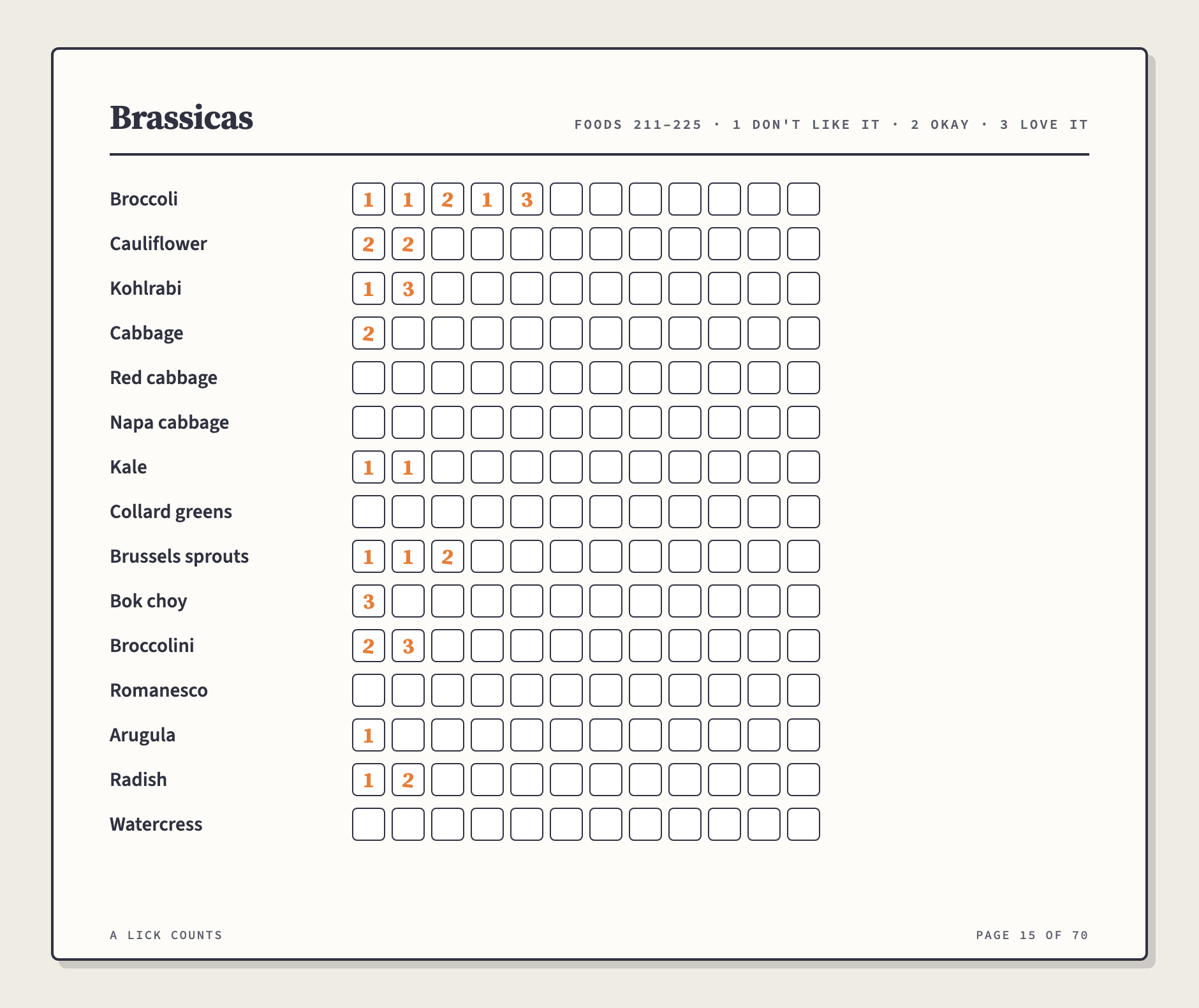
Every other food journal asks the child to make an entry — write the food, draw it, give it stars. That's work, and a 4-year-old won't do it twice. This book prints the whole universe up front instead: about 1,000 foods organized by kind, roughly 70 landscape grid pages that lie flat, on heavy paper a crayon can live on. Each food gets a row of squares filled left to right, so a long row means a food that kept coming back — "1, 1, 2, 1, 3" is the story. The scale is 1 (don't like it), 2 (okay), 3 (love it), and three self-inking stamps ship with the book so the number is a thing the kid gets to do.
- Foods
- About 1,000, organized by kind
- Pages
- Roughly 70, landscape, wire-bound
- Scale
- 1 · 2 · 3, three stamps included
- Price
- $24–29, being tested
A lick counts
Touching it to the tongue and putting it back is enough — the instant a square requires a swallowed bite, the bargaining every parent already knows comes back. There's no date column and no percent complete, because the moment completion becomes a number the goal shifts from "trying is fun" to "finish the page." And a 1 has to stay a real answer, not a failure: if a kid suspects the parent wants a 3, the ratings become performance and the book stops working. The science is real — Cooke et al., 2011 found twelve daily pea-sized tastes of a disliked vegetable raised liking, and the kids who got a small tangible reward were the only group still eating more three months later. The stamp is that reward.
12 tastes turns "no" into "fine"
The grocery store is the game board
Pokémon GO's trick wasn't the Pokédex; it was that a sidewalk you'd walked a thousand times suddenly had things on it. The grocery store is a better version — it already has the nodes, it changes with the season, and you're going anyway. Finding the food in the book is a minute of curiosity before the bite. A year in, success looks like a book that's scuffed and a third full, a kid who brings up kohlrabi in the cart because it's on the same page as broccoli, and nobody having said "just try it" in months — the squares did the nagging without a word.
Nobody has made an i-SPY book for food
Per-entry journals like "I Tried This!" are blank review forms a kid can't log a tenth taste in. Sticker passports are a one-pass souvenir — the stickers run out, and with no taxonomy there's nothing to hunt for. Tiny Tastes, the clinical original from UCL, proved the science and never became a shelf product. The closest cousin is i-SPY — a pre-printed list of birds or cars you score yourself — and nobody has made one for food. The price being tested is $24–29 with the stamps; it started at $19, but a book that costs $6–9 to print and $5–8 to ship leaves nothing at $19 to tell anyone it exists.
Want to talk about Food Journal?
Get in touch →coachhouse.so/food-journal