
Japan for the blossoms. The safari. All fifty states before the oldest graduates. Every family has the list, and it lives in a notes app that gets read aloud every January and agreed with by everyone. Then spring break gets booked in February because someone remembered, summer goes to the same rental it always goes to, and Japan stays on the list — peak blossom is a two-week window and nobody was watching for it.
A six-year-old gives you eight summers, not twelve
Most kids remember little before seven, and somewhere around sixteen they stop wanting to come. Graduation is the horizon you're planning to; it isn't the horizon you have. The same arithmetic runs for an empty-nester who wants one trip a year with grown kids, or the college friends who've spent a decade saying "we should do a big one" — a fixed group, a closing window, and a list nobody has put dates on.
The unit is the decade, not the trip
Almanac is software a travel advisor uses to turn that list into a dated ten-year plan and hold it for as long as it takes to finish. Every other tool in the category models one trip — a beautiful proposal that goes quiet the moment the client boards. Almanac's solver holds five things at once: seasons (the Serengeti migration runs July to October), school calendars, ages (who'll still be living at home in 2031), money (a $44,000 safari needs a year nothing else has claimed), and geography (one well-routed road trip takes six states off the list). Every trip lands in a year and a season with the reason it sits there written underneath.
When life moves, the plan reshuffles
A trip-by-trip advisor has two options when something goes wrong: cancel, or postpone. Both cost the family a year. An advisor holding ten dated trips has a third — pull Portugal forward, push Spain back two years, and the summer still happens, because there is always another trip whose season fits. The reshuffle takes one conversation, and it's why the second year of the retainer is worth as much as the first.
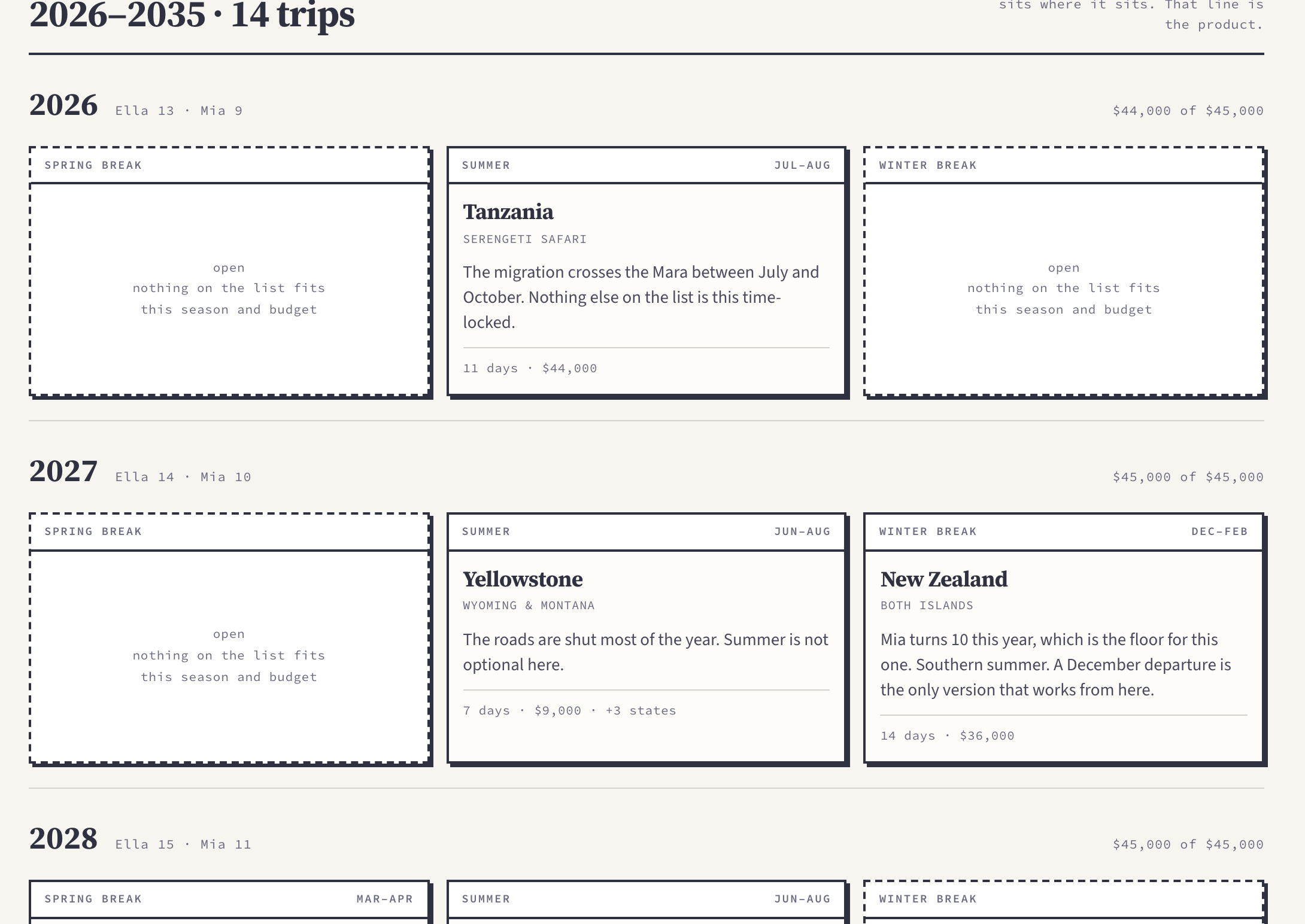
Try the toy
Two kids, a bucket list, and a budget you can drag around to watch a decade rearrange. Forty destinations with genuine season windows and hand-typed costs — everything that makes a plan yours rather than plausible is left out on purpose.
The family owns the plan
The obvious build is inside a host agency, where the plan becomes a retention device and switching advisors means losing it. Almanac's is portable by design: the family owns it, and if they change advisors it goes with them. That gives up the cheapest kind of lock-in and buys the only defense that matters — a host agency has no reason to build a plan that walks out the door. The family pays her a $3,000–6,000 annual retainer, in the empty band between per-trip planning at about $2,800 and the $50,000 concierge version; the advisor pays Almanac $500 per active family plan per year, priced per plan rather than per seat, because this is something she resells rather than software that saves her time.
Nothing has been sold yet
This is at the idea stage. No advisor has used it, the prototype runs on hand-typed data, and the best finding behind it — that elite concierges already plan a decade out, at retainers reported to reach $50,000 — traces to a single outlet and needs a second source. The cheapest test is one advisor, one family, one hand-built plan, and an actual ask for money. Almanac is also a working name: the software trademark is dead, but the live marks belong to a publisher.
Want to talk about Almanac?
Get in touch →coachhouse.so/almanac